

Happy Feast of Saint Augustine!
Augustine is one of the most well known of the early Church Fathers, and his writings, especially the Confessions and The City of God have impacted millions of people throughout the last fifteen centuries.
I share this because Saint Augustine is one of the disciples chronicled in a book I just finished reading. by Cardinal Fernando Filoni entitled, My Days Are in Your Hands: Men and Women in the Footsteps of Jesus.
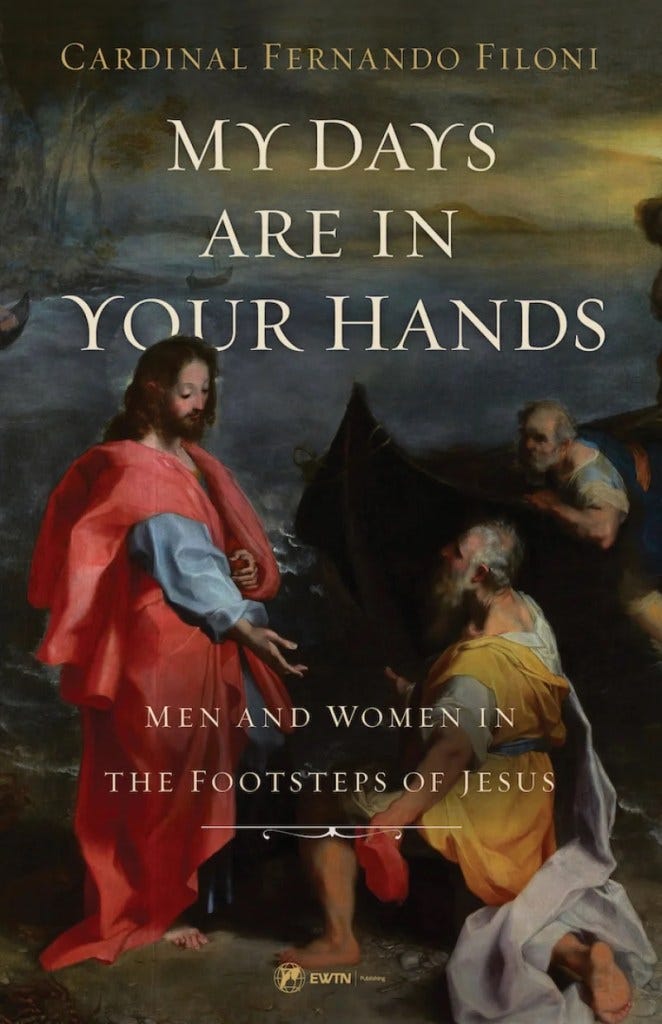
One of the things I appreciated most while reading Cardinal Filoni’s book was the wonderful diversity of the people whose stories fill its pages. They come from Scripture and from the centuries that have followed. Each of those included in the pages come from remarkably different circumstances and walks of life, yet each offers us a glimpse of what it means to place our lives—and our days—into the hands of God.
That diversity is one of the great strengths of this book. In its pages, you encounter familiar biblical figures such as Abraham, Moses, John the Baptist, Mary, Joseph, Mary Magdalene, Peter, and Paul, but then also some of the world’s most well known saints like Augustine, Helena, Francis, Thomas Aquinas, and Mother Teresa. Cardinal Filoni invites us to look at each of them again through the lens of discipleship.
As the book moves through the centuries, we discover again and again that following Christ is never limited to only one personality, vocation, temperament, or path to holiness. The circumstances may change, but the invitation remains the same: to encounter Christ, surrender ourselves to Him, and then allow that encounter to shape how we live.
I particularly enjoyed the way Cardinal Filoni organizes each of the encounters. He first allows us to become acquainted—or reacquainted—with the disciple by sharing the story of his or her life, and only then does he move into reflection upon the significance of that life. He asks questions like: What difference did this person make? What can we learn from the choices he or she made? Where was God at work in that person’s circumstances?
But the book doesn’t stop there.
Cardinal Filoni continually brings the question of what it is like to place one’s life into God’s hands back to the reader by reminding us that the lives of these disciples aren’t simply interesting stories from Scripture or Church history to be admired from a comfortable distance. Rather, their witness should challenge us to consider how the lessons of their lives might actually be lived in our own circumstances, relationships, responsibilities, struggles, and opportunities.

And this is what makes My Days Are in Your Hands much more than just a collection of short biographies. Instead, it serves as a continuous invitation to discipleship through the sharing of those stories.
For me, I found this invitation to be very reassuring. As I reflected upon the diverse collection of men and women Cardinal Filoni highlights, it reaffirmed what I have intuitively always known–that holiness does not belongs only to a particular “type” of person. God has worked through people who were courageous or hesitant, prominent or obscure, strong or struggling. Their paths towards sanctity were different because their lives were different—just like our lives are. What each of them has in common was their willingness to entrust their lives to God and follow where He led.
In this, the book’s title is absolutely spot on. For “My days are in your hands” is not simply a beautiful spiritual sentiment, but is a way of approaching life.
Each one of us has been given a particular number of days, a particular set of circumstances, and a particular opportunity to respond to God, just like the disciples Cardinal Filoni chronicles, and it is up to us to SAY YES to the invitation God presents to us to put our days into His Hands.
I highly recommend this book to anyone looking for a spiritually enriching, but also a very practical exploration of Christian discipleship. It is especially valuable for personal spiritual reading because Cardinal Filoni has designed it so that each section naturally lends itself to prayer and reflection. But it would also work well within a small group, or used as a parish formation program, or simply by a group of like-minded people seeking to deepen their understanding of what it means to follow Jesus in everyday life on the journey towards holiness.
Ultimately, Cardinal Filoni doesn’t simply introduce us to men and women who followed Jesus. He invites us to join them. And that is perhaps the biggest question I carried away from this book is this: My days are in God’s hands—but what am I choosing to do with the days He has given me?
That final question continues to sit with me today, and I invite you to sit with it as well on your own journey of discipleship. AMDG!
Holiness is something God calls all of us to, and since we are all so unique - and He knows that uniqueness so intimately - there are a seemingly infinite number of paths to holiness. I love stories of the saints because they remind me of this beautiful truth. I'll consider checking out this book. God bless you!